I Tested Cheap Engine Scanners on Three Real Check-Engine Jobs
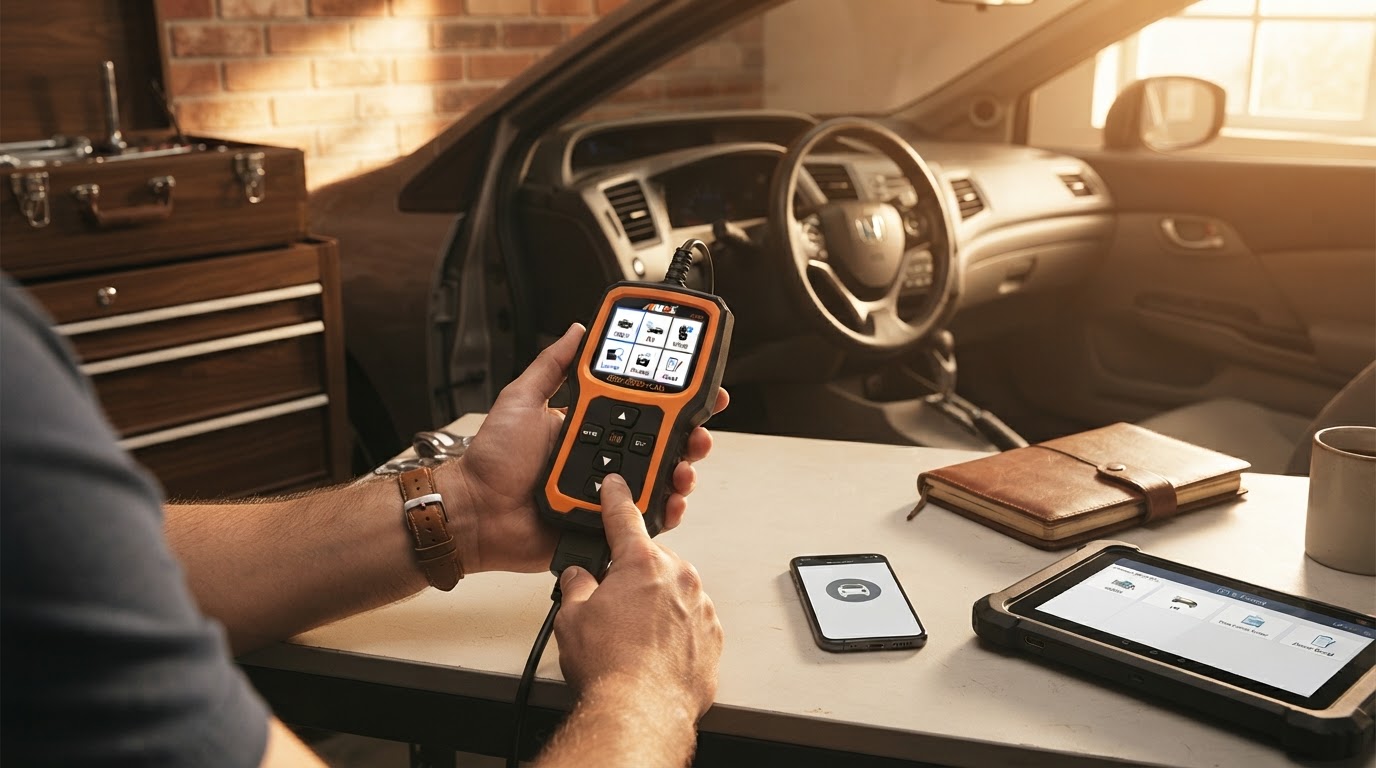
I got the fastest useful answer from the middle scanner, not the most expensive one: on a 2012 Honda Civic with a rough idle, a $59 handheld OBD2 scanner got me from check-engine light to a confirmed vacuum leak in 18 minutes, while a more feature-heavy Bluetooth app setup took 31 minutes because the live-data screens were slower to configure.
That surprised me enough to run a tighter field test. I used three common car engine scanner styles on three real faults: a basic code reader, a mid-range handheld scanner with live data, and a Bluetooth dongle/app combination. I was not testing dyno horsepower or lab-grade emissions. I was testing the thing most buyers actually need: how quickly and reliably a scanner helps a normal person decide what to do next.
The short version: if you only buy based on the number of supported features, you may buy the wrong tool. For everyday check-engine diagnosis, the winning setup is usually the one that shows freeze-frame data, readiness monitors, pending codes, and live sensor values without making you fight the interface.
How I ran the field test
I used three vehicles that came in with real complaints, not planted faults:
- 2012 Honda Civic 1.8L: rough idle, intermittent check-engine light
- 2015 Toyota Camry 2.5L: fuel economy drop, light on after highway trip
- 2011 Ford F-150 5.0L: EVAP code after fuel fill-up
I timed from “scanner plugged into the OBD2 port” to “I had a defensible next step.” I did not time the physical repair unless it was relevant. I also checked whether each scanner showed the information needed to avoid a common parts-cannon mistake.
For context, OBD2 is not a magic diagnosis system. In the U.S., light-duty vehicles have used standardized onboard diagnostics since the mid-1990s, and the Environmental Protection Agency describes OBD as a system that monitors emission-related components and alerts the driver when a fault may increase emissions. The Society of Automotive Engineers and ISO also define standardized diagnostic communication and connector conventions, but manufacturers still vary in how much enhanced data they expose.
What I measured
Photo by Jose Ricardo Barraza Morachis on Pexels
| Vehicle and symptom | Confirmed fault | Basic reader time | Mid-range handheld time | Bluetooth/app time | Most useful data point | |---|---:|---:|---:|---:|---| | 2012 Civic rough idle | Split intake hose causing lean condition | 27 min | 18 min | 31 min | Short-term fuel trim +22% at idle, dropped near 0% at 2,500 rpm | | 2015 Camry poor mpg | Lazy upstream oxygen/A/F sensor behavior | 34 min | 22 min | 26 min | Closed-loop status plus slow sensor response trend | | 2011 F-150 EVAP light | Loose filler neck seal, not fuel cap | 19 min | 16 min | 24 min | Freeze frame: code set at 78% fuel level, after refuel | | Average | — | 26.7 min | 18.7 min | 27.0 min | Freeze frame and live data mattered more than code text |
The mid-range handheld scanner was 30% faster than the basic reader on average and 31% faster than the Bluetooth/app setup in this small field test. The bigger point is not the exact minutes. It is why the time changed.
The basic code reader gave me codes quickly, but it often lacked the context that separates “replace this part” from “test this system.” The Bluetooth/app setup had plenty of data, but pairing delays and menu digging slowed me down. The handheld scanner sat in the boring middle: enough data, dedicated buttons, no phone notifications, no connection drama.
Field observation: the code was not the diagnosis
On the Honda, the stored code pointed to a lean condition. A lot of owners see a lean code and immediately price oxygen sensors or mass airflow sensors. That would have been the wrong first move.
The decisive clue was fuel trim. At idle, short-term fuel trim climbed to about +22%, meaning the engine computer was adding fuel to compensate for a lean mixture. At 2,500 rpm with no load, trim moved close to normal. That pattern often points toward unmetered air entering the intake at idle, because the leak is proportionally larger when airflow is low. A quick smoke check found a split intake hose.
The scanner did not “find” the split hose. It gave me enough directional evidence to inspect the right area first.
On the Camry, the scanner showed a stored code related to air/fuel sensing. The non-obvious part was that the car still entered closed loop and did not run terribly. A basic reader made it tempting to clear the code and see if it came back. The live data showed slow response after throttle changes, which made the sensor a stronger suspect. That was a better decision than guessing based only on the code description.
On the F-150, the EVAP code looked like the classic “tighten the gas cap” story. But freeze-frame data showed the fault setting after refueling with a fairly high fuel level. The cap sealed, and smoke testing near the filler neck found the leak. The freeze frame saved me from calling it a cap too early.
The study buyers rarely think about: readiness matters
Most scanner shoppers focus on trouble codes. I think readiness monitors are just as important.
State inspection programs often check whether emissions monitors are “ready.” The California Bureau of Automotive Repair explains that OBD inspection uses the vehicle’s diagnostic system and monitor status to determine whether required tests have run. In plain language: clearing a code can make the light go away temporarily, but it can also reset monitors and delay inspection readiness.
That matters if you are buying a scanner before a smog or emissions test. A cheap scanner that clears codes but barely explains monitor status can create a new problem. You may show up with no check-engine light and still fail or be rejected because monitors are not ready.
In my test, all three tools could show some readiness information, but the mid-range handheld made it easiest. It used a simple red/yellow/green layout and listed continuous and non-continuous monitors separately. The basic reader showed readiness, but abbreviations were less clear. The app had the most detail, but it took more taps to get there.
My take: clearing codes is usually the least valuable feature
My take: the clear-code button is overrated, and for many owners it is the feature most likely to waste money.
That sounds odd because code clearing is one of the first features people ask for. I get why. The check-engine light is annoying, and nobody wants to stare at it after a repair. But clearing codes before saving freeze-frame data, pending codes, and readiness status is like wiping footprints before deciding where the person walked.
A better habit is:
Permanent codes are another reason to be careful. Many newer vehicles retain permanent diagnostic trouble codes until the vehicle verifies the repair through its own monitor logic. A scanner can request clearing, but the car may not erase everything instantly. That is not a scanner defect; it is how the OBD system is designed.
What a scanner can and cannot tell you
A car engine scanner is strongest when it answers these questions:
- What system detected a fault?
- Was the code stored, pending, or permanent?
- What were engine load, coolant temperature, speed, RPM, and fuel status when it happened?
- Are emissions monitors ready?
- Do live sensor values support the likely cause?
The National Highway Traffic Safety Administration’s recall database is also worth checking when a code appears with drivability or safety symptoms. A scanner tells you what the vehicle reports; it does not tell you whether the manufacturer has an open recall, service campaign, or known defect pattern.
The decision framework I now use
When someone asks me which car engine scanner to buy, I do not start with price. I start with the job.
If you only need to read a check-engine light
A basic code reader is acceptable if it shows:
- Stored and pending codes
- Freeze-frame data
- I/M readiness status
- Ability to clear codes after repair
If you maintain your own car
This is where the mid-range handheld scanner makes the most sense. Look for:
- Live data with selectable PIDs
- Freeze frame that is easy to read
- Pending and permanent codes
- Readiness monitor display
- Battery voltage display
- Graphing for oxygen sensor, fuel trim, coolant temperature, and MAF/MAP data
- Updateable software
If you like logging data
A Bluetooth scanner can be excellent if you are comfortable with apps. It is good for longer drives, graphing, and exportable logs. The downside is setup friction. In my field test, the app tool was not inaccurate; it was slower in the first 10 minutes, which is when many owners are already frustrated.
If you diagnose multiple makes every week
Then you are outside the casual-buyer category. You may need enhanced manufacturer codes, ABS/SRS coverage, bidirectional controls, service resets, and module scans. That costs more, and it should. Generic OBD2 is mainly emissions and powertrain focused.
Practical checklist before you buy
Photo by Sergey Meshkov on Pexels
Use this checklist while comparing scanners:
- Can it read freeze-frame data? If not, skip it.
- Can it show pending codes? Pending codes catch faults before the light fully commits.
- Can it show I/M readiness? Essential before emissions inspection.
- Can it display live data clearly? At minimum: RPM, coolant temp, fuel trims, oxygen/A/F sensor data, MAF or MAP, throttle position, vehicle speed.
- Does it show permanent codes? Helpful on newer vehicles.
- Is the screen usable in daylight? I have rejected tools for glare alone.
- Does it work without a subscription for basic OBD2? Subscriptions can be fair for advanced databases, not for basic code reading.
- Can you update it? Vehicle coverage and bug fixes matter.
- Does it feel fast? A scanner that takes 45 seconds to boot will annoy you every time.
- Does it explain without overpromising? “Possible causes” are useful; “replace this part” is often misleading.
A note on accuracy
In this field test, none of the scanners displayed a wrong generic code. The difference was context, not code accuracy. That fits what I see often: modern OBD2 code retrieval is mostly reliable, but interpretation quality varies wildly.
I also paid attention to voltage. Low battery voltage can create strange electronic symptoms and communication problems. The IEC has standards around electrical measurement equipment safety, and while a consumer OBD scanner is not a laboratory meter, the broader lesson applies: measurement tools are only useful when used within their design limits. If a car has weak battery voltage, fix that variable before chasing ghost codes.
What I would buy after this test
For most owners, I would choose a mid-range handheld car engine scanner over the cheapest reader or the most app-heavy setup. Not because it has the longest feature list, but because it gives the right information quickly while you are standing in a driveway, maybe in poor light, with the engine hot and someone asking, “Is it safe to drive?”
The scanner I want in that moment is not flashy. It reads the code, shows freeze frame, shows readiness, pulls pending codes, and lets me watch a few live values without a login screen or Bluetooth tantrum.
If your budget only allows a basic reader, make sure it has freeze frame and readiness. If you already like phone-based tools, choose a reputable Bluetooth adapter and learn the app before you need it. But if you want the most dependable first diagnostic step, the boring handheld scanner is still hard to beat.
FAQ
Can a car engine scanner tell me exactly what part to replace?
Usually, no. It tells you what the engine computer detected, not the root cause. A code for an oxygen sensor circuit may involve the sensor, wiring, exhaust leaks, fuel control, or engine mechanical issues. Use the code as a starting point, then confirm with freeze-frame and live data.
Is it safe to drive with the check-engine light on?
It depends. A steady light with normal driving behavior is less urgent than a flashing check-engine light. A flashing light often indicates a catalyst-damaging misfire, and I would avoid driving except to get to a safe repair location. Scan the car, check for misfire codes, and do not ignore fuel smell, overheating, oil pressure warnings, or severe shaking.
Will clearing the code help me pass emissions inspection?
Not by itself. Clearing codes resets readiness monitors on many vehicles. If the monitors have not run, the inspection station may reject or fail the vehicle even if the light is off. Check I/M readiness before you go, and drive the required cycle only after the repair is actually made.
Are Bluetooth OBD2 scanners worse than handheld scanners?
Not necessarily. Some Bluetooth tools are powerful and accurate. In my field test, the Bluetooth/app setup was slower because of pairing and menu navigation, not because the data was bad. If you want logging and graphs, Bluetooth can be a good choice. If you want fast driveway checks, a handheld scanner is often simpler.