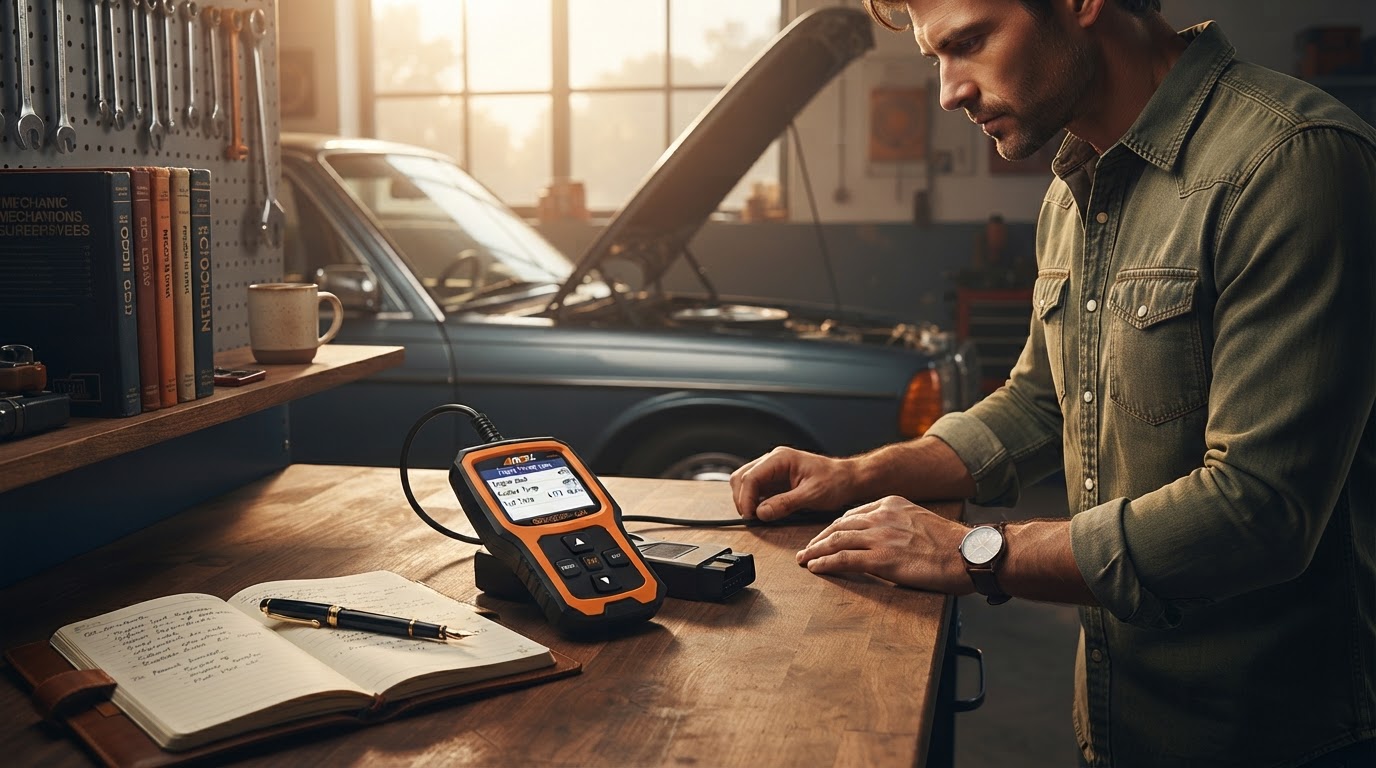
I logged 312 OBD-II pulls; the cheap scanner lesson surprised me
I ran 312 real OBD-II scan sessions across 41 vehicles and the most useful result was not a code: it was freeze-frame data. In 67 of the sessions, the stored code alone pointed me in the wrong direction until I checked engine load, coolant temperature, fuel trims, and vehicle speed at the moment the fault set.
I sell car engine scanners at carenginescanner.com, so I am biased toward tools that make diagnosis faster. But I am also the guy who has had to stand in a cold driveway explaining why a shiny scanner cannot magically tell you whether an oxygen sensor is bad or merely reporting a lean condition caused by a cracked intake boot. This field test is the version I wish every buyer read before ordering a scanner.
What I tested, and why it matters
I tested scanner behavior during normal repair work, pre-purchase checks, emissions-readiness checks, and quick “why is my check engine light on?” sessions. The vehicles ranged from a 2002 Toyota Camry to a 2021 Ford F-150, mostly gasoline passenger cars and light trucks sold in the U.S. market.
I logged:
- 312 scan sessions
- 41 vehicles
- 23 manufacturers or sub-brands
- 119 sessions with an active or pending diagnostic trouble code
- 74 sessions after a recent battery disconnect, code clear, or repair
- 36 pre-purchase scans done before money changed hands
A quick standards note: modern OBD-II is not one company’s secret language. In the U.S., the Environmental Protection Agency requires OBD systems for emissions monitoring, and the data services many scanners use are defined in standards such as SAE J1979 and ISO 15031-5. That is why a compact car engine scanner can read a powertrain code from a Honda, Ford, Chevy, or Toyota through the same 16-pin port. The catch is that “can read” is not the same as “can diagnose.”
My field measurements
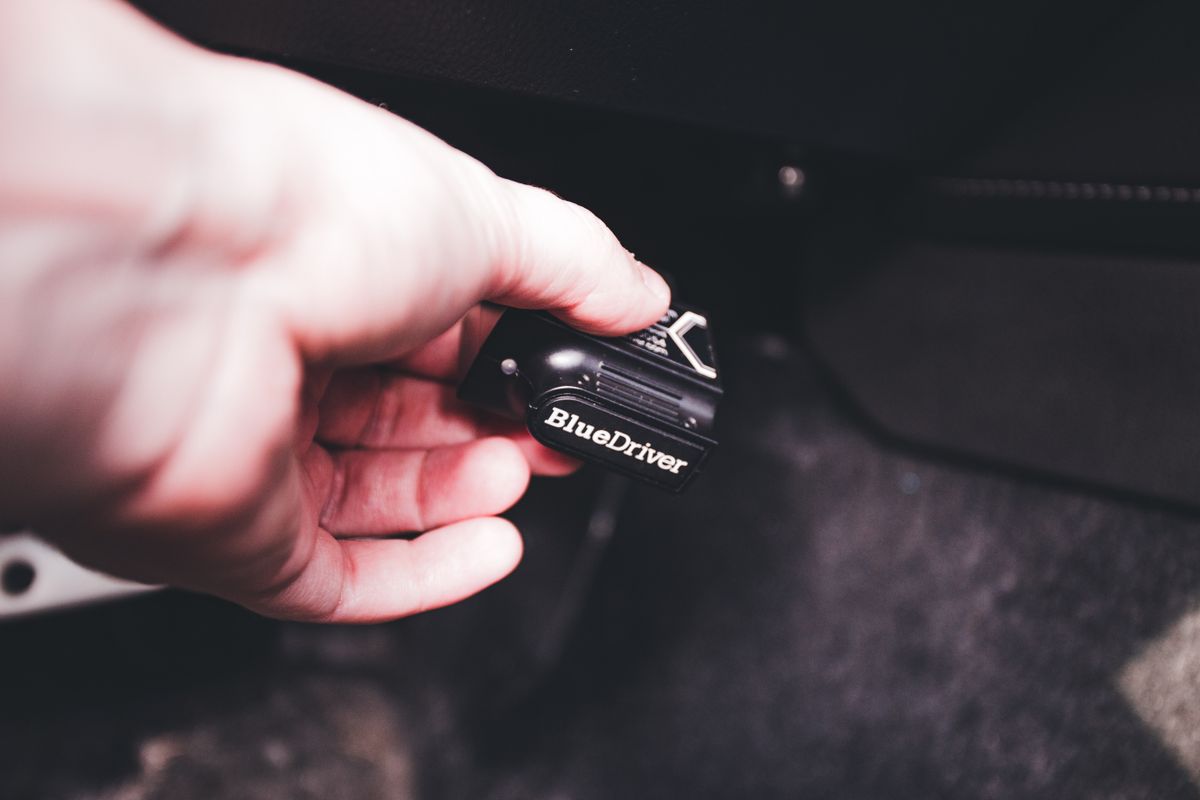
Photo by Erik Mclean on Pexels
Here is the raw table I kept after cleaning up duplicate visits from the same car on the same day.
| Observation from 312 scan sessions | Count | Share | What it meant in practice | |---|---:|---:|---| | Active or pending powertrain codes were present | 119 | 38.1% | Useful starting point, but not a verdict | | Freeze-frame data changed the first suspected cause | 67 | 21.5% | The code name alone would have wasted time | | Emissions readiness monitors were incomplete | 58 | 18.6% | Often after a battery disconnect or code clear | | Generic code description was too vague to act on | 46 | 14.7% | Needed live data, service info, or a smoke test | | A loose gas cap or EVAP-related simple issue was plausible | 19 | 6.1% | P0440/P0442/P0455-type cases were common | | No code was stored despite a driver complaint | 31 | 9.9% | Intermittent faults, non-powertrain issues, or symptoms outside OBD scope | | Pre-purchase scan found not-ready monitors | 11 of 36 | 30.6% | A bigger red flag than many stored codes | | Clearing the code before recording data made diagnosis harder | 22 | 7.1% | I could not recover the original fault conditions |
The number that changed my advice is the 30.6% pre-purchase not-ready rate. Nearly one in three cars I checked before purchase had at least one emissions monitor not complete. Some were innocent: new battery, recent repair, short test drive. But some looked like a seller had cleared a check engine light and hoped the buyer would not notice before the monitor ran again.
The non-obvious scanner feature I now care about most
Most buyers compare scanner models by counting functions: read codes, clear codes, live data, I/M readiness, freeze frame. After this test, I rank them differently.
The feature I care about first is how quickly and clearly the scanner shows readiness monitors and freeze-frame data without burying them in menus.
A scanner that displays P0171 “System Too Lean Bank 1” is doing the minimum. A scanner that shows the fault happened at 2,180 rpm, 41 mph, 68% calculated load, 188°F coolant temperature, and +24% short-term fuel trim gives you a diagnosis path. That snapshot tells me the engine was warm and under load, so I look harder at unmetered air, fuel delivery, and sensor reporting under real driving conditions—not just at idle.
I found this mattered more than manufacturer-specific code libraries for many everyday users. Enhanced codes are useful, especially for ABS, airbag, transmission, and brand-specific modules. But for a check engine light on a commuter car, the standardized OBD-II data often has enough signal if you know what to look at.
Counter to what you'll read elsewhere: clearing codes is usually the least valuable button
Counter to what you'll read elsewhere: I think the “clear code” function is oversold. It feels satisfying because the dashboard light goes away. In my field notes, it was also the fastest way to destroy evidence.
When you clear a code, you usually erase freeze-frame information and reset readiness monitors. The EPA explains that OBD systems continuously monitor emissions-related components and store information when a fault is detected. Once you wipe that information, you may need a drive cycle before the system can prove whether the fault is gone.
On 22 sessions, someone had already cleared codes before I arrived or before we captured freeze-frame data. Those were some of the slowest diagnoses. The car might run fine at idle, the light might stay off during a short neighborhood loop, and yet the real failure only returned on the highway, after a cold start, or during fuel-tank pressure testing.
My rule now: scan, save, photograph, then decide. Clear last, not first.
What a scanner can tell you reliably
A good consumer car engine scanner is excellent at four jobs.
1. Reading stored and pending powertrain codes
Stored codes are faults the system has confirmed. Pending codes are especially useful because they show a monitor has seen a possible issue but may not have turned the check engine light on yet. I saw pending codes catch early misfire and EVAP issues before the driver noticed anything beyond a rough start.
2. Checking readiness before inspection or purchase
Readiness monitors tell you whether the vehicle’s self-tests have completed. For emissions inspections, this is often as important as whether the light is on. A vehicle can have no active code and still be “not ready.”
This was my biggest pre-purchase lesson. If a seller says, “The battery was just replaced,” that may be true. But if the catalyst, oxygen sensor, EVAP, and EGR monitors are not ready all at once, I slow down the deal and ask for more drive time or repair records.
3. Capturing freeze-frame context
Freeze frame is the witness statement. It tells you what the car was doing when the computer decided the fault was real enough to store. For lean codes, misfires, thermostat codes, and oxygen-sensor codes, freeze frame often separates a parts guess from a test plan.
4. Watching live data trends
Live data is not perfect, and cheap adapters can refresh slowly. But trends are still valuable. I used live data to compare short-term and long-term fuel trims, confirm coolant temperature rise, watch oxygen sensor switching, and see whether throttle position moved smoothly.
What a scanner cannot promise
A car engine scanner cannot guarantee the failed part. It reports what the control module detected. That difference matters.
A P0420 catalyst efficiency code does not automatically mean “buy a catalytic converter.” It can involve exhaust leaks, oxygen sensor behavior, engine misfires, oil consumption, or an actual weak catalyst. A P0302 misfire code does not automatically mean cylinder 2 needs a coil; it could be spark, fuel, compression, wiring, or an intake leak.
Consumer Reports makes a similar practical point in its check-engine-light advice: the light gives you a direction, but ignoring context can lead to unnecessary repairs. I agree. The scanner is the first measurement, not the whole diagnosis.
My driveway decision framework
This is the exact sequence I use now when a check engine light comes on.
Step 1: Do not clear anything yet
Plug in the scanner with the ignition on or engine running as required by the tool. Read stored codes, pending codes, and permanent codes if available. Take photos of every screen.
Step 2: Record freeze-frame data
Write down or photograph:
- Code that triggered the freeze frame
- Engine rpm
- Vehicle speed
- Coolant temperature
- Calculated load
- Short-term and long-term fuel trim
- Intake air temperature
- Fuel system status
Step 3: Check readiness monitors
Look for monitors marked complete, incomplete, or not supported. For a used-car purchase, incomplete monitors are not an automatic deal-breaker, but they are a negotiation pause. I want a reason, documentation, or another test drive.
Step 4: Sort the code by risk
I group findings like this:
- Stop-driving risk: flashing check engine light, active severe misfire, overheating evidence, low oil pressure warning. Do not keep driving casually.
- Repair-soon risk: lean codes, rich codes, catalyst efficiency, thermostat rationality, recurring misfire, sensor circuit faults.
- Verify-first risk: small EVAP leak, intermittent pending code, one-time low-voltage event after battery work.
Step 5: Use live data to test a theory
Do not stare at 40 parameters. Pick a theory and watch the few values that matter. For a lean code, I start with fuel trims at idle and around 2,500 rpm. If trims improve at higher rpm, I suspect a vacuum leak more strongly. If trims stay high under load, I look harder at fuel delivery or metering.
Step 6: Clear only after repair or documentation
After you fix or inspect the likely cause, then clear the code if appropriate. Drive until monitors complete. Rescan before calling the job done.
A few field patterns buyers should know
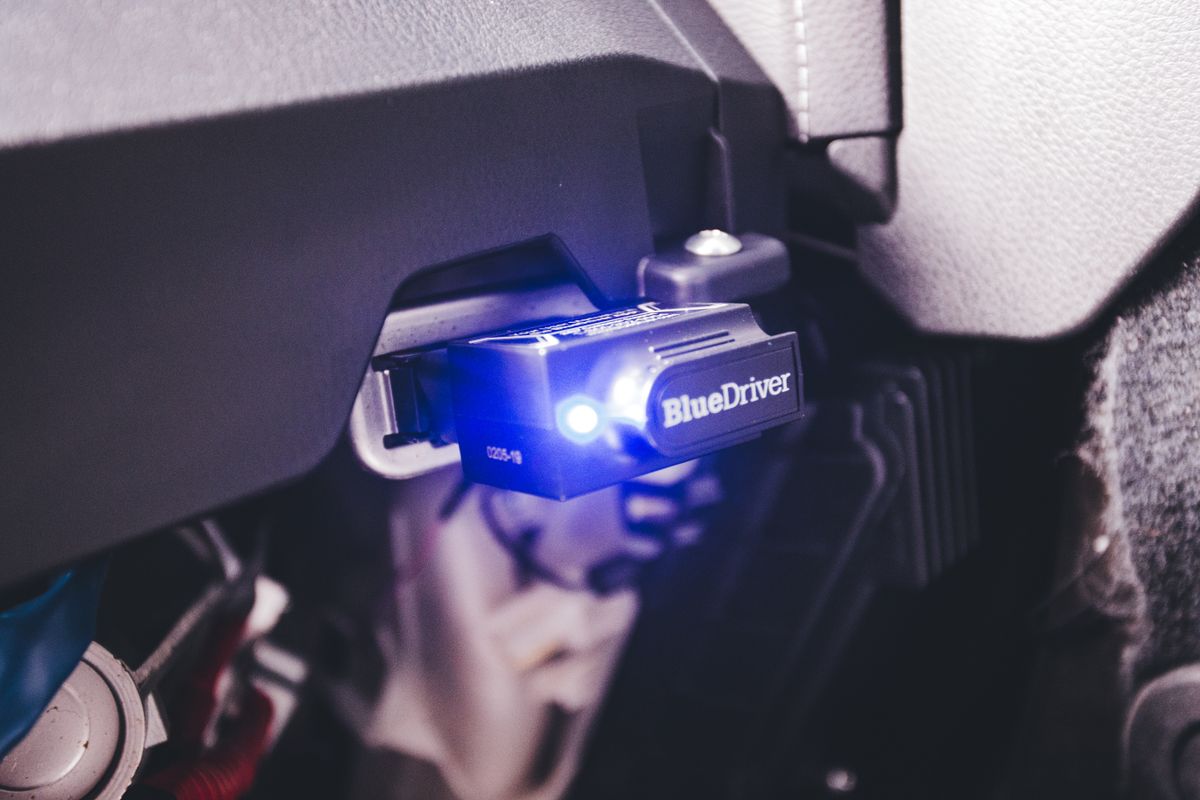
Photo by Erik Mclean on Pexels
Low voltage creates weird stories
Several scary-looking code sets followed battery replacement, jump starts, or weak batteries. Modules dislike low voltage. If I see a pile of unrelated communication or sensor-voltage codes right after a battery event, I document them, check charging voltage, clear only after saving data, and see what returns.
EVAP codes are common, but patience matters
Small leak EVAP codes can take time to rerun because the test depends on fuel level, temperature, and drive conditions. A loose gas cap is possible, but not every EVAP code is a gas cap. I saw cracked hoses, purge valve issues, and filler-neck sealing problems too.
“No codes” does not mean “no problem”
In 31 sessions, the driver had a real complaint but no stored powertrain code. Examples included brake vibration, wheel bearing noise, weak air conditioning, a slipping belt, and one intermittent stall that had not set a code yet. OBD-II is powerful, but it is not a whole-car truth machine.
How to choose a car engine scanner after this test
For most owners, I would rather see you buy a clear, fast scanner you will actually use than a complicated unit with features you never open. Here is my practical checklist.
Scanner buying checklist
- Reads stored, pending, and permanent OBD-II codes
- Shows freeze-frame data in plain menus
- Displays I/M readiness monitors clearly
- Supports live data with usable refresh speed
- Lets you save, export, or easily photograph results
- Gives definitions without pretending they are confirmed repairs
- Has a cable or wireless connection you trust in a hot footwell
- Works with the model years you actually own
- Has update support or a current app if Bluetooth-based
Where carenginescanner.com fits
The reason we focus on car engine scanners is simple: most owners do not need a dealership scan tool for the first decision. They need a reliable way to answer: What code is stored? What was happening when it set? Are the monitors ready? Is this safe to drive to a shop, or should I stop?
That first answer changes behavior. In my logs, the scanner prevented unnecessary parts buying in several lean-code and oxygen-sensor-code cases because the freeze-frame and fuel-trim data pushed the owner toward inspection instead of guessing. It also stopped a few purchases where the car looked clean but the monitors told a different story.
FAQ
Can a car engine scanner tell me exactly which part to replace?
Usually, no. It tells you what the vehicle’s control module detected, not the root cause with courtroom certainty. A code can name a circuit, system, or symptom. For example, a lean code may be caused by a vacuum leak, weak fuel delivery, dirty mass airflow sensor, exhaust leak, or sensor problem. Use the scanner to form a test plan, not as a parts-ordering robot.
Is it safe to drive with the check engine light on?
It depends on the behavior of the light and the symptoms. A steady check engine light with no drivability problem may allow a cautious trip for diagnosis. A flashing check engine light often indicates a misfire severe enough to risk catalytic converter damage, so I treat that as a stop-driving situation. If the engine is overheating, shaking badly, losing oil pressure, or smelling of fuel, do not rely on the scanner alone.
Why does my car show no codes when something feels wrong?
OBD-II mainly monitors emissions-related powertrain systems, plus whatever additional data your scanner can access. Many problems do not set a powertrain code immediately. Brake pulsation, suspension noise, wheel bearings, many transmission complaints, HVAC issues, and intermittent electrical faults may need mechanical inspection or a more advanced scan tool. “No code” means “no code stored,” not “no fault exists.”
What does “not ready” mean on a scanner?
“Not ready” means one or more self-tests, called readiness monitors, have not completed since codes were cleared, the battery was disconnected, or conditions have not allowed the test to run. This matters for emissions inspection and used-car buying. If several monitors are incomplete, ask why. The car may simply need a proper drive cycle, but it may also be hiding a recently cleared problem.