Basic vs Enhanced OBD2 Scanners: What DIY Mechanics Actually Need
Should you buy a basic $15 OBD2 code reader or invest in an enhanced scanner like the ANCEL AD410? Basic code readers only pull generic diagnostic trouble codes (DTCs), leaving you blind to active fuel trims, EVAP leaks, and intermittent misfires. DIY mechanics need an enhanced scanner featuring Mode 6, live sensor telemetry, freeze frame snapshots, and EVAP system leak testing to accurately diagnose and resolve engine faults.
Diagnostic Feature Matrix: Basic vs. Enhanced Scanners
| Failure Mode / Diagnostic Task | Basic Code Reader ($10-$20) | Enhanced OBD2 Scanner (ANCEL AD410) | Diagnostic Impact & DIY Necessity |
| --- | --- | --- | --- |
| Intermittent Engine Misfire (P0300-P0308) | Displays stored DTC code only after Check Engine Light illuminates. | Accesses Mode 6 per-cylinder misfire counters & live RPM/ignition timing streams. | Crucial for identifying a failing spark plug or ignition coil before catalytic converter failure occurs. |
| Evaporative Emission System Leak (P0440-P0457) | Reads generic code; cannot verify system seal or monitor pressure. | Initiates EVAP leak test monitoring and tracks fuel tank pressure sensor data. | Saves $200+ in diagnostic fees by verifying EVAP system integrity after replacing gas cap or purge valve. |
| Catalyst & O2 Sensor Failure (P0130-P0420) | Triggers hard fault code; no sensor performance context. | Graphs live O2 sensor voltage waveforms and evaluates Mode 6 catalyst monitors. | Prevents replacing an expensive catalytic converter when the real issue is an upstream O2 sensor or exhaust leak. |
| Intermittent Fault Under Acceleration | Offers no operational parameters at time of fault. | Captures Freeze Frame data (Engine Load, Coolant Temp, Fuel Trim at trigger moment). | Pinpoints exact engine operating conditions when the Powertrain Control Module (PCM) logged the error. |
| State Smog Inspection Readiness | Shows basic MIL status without detailed monitor state. | Displays complete I/M Readiness status for O2, EVAP, EGR, and Catalyst monitors. | Guarantees all emission monitors are set to 'Ready' status before paying for state inspection fees. |
A side-by-side comparison of diagnostic capabilities when troubleshooting common automotive failure modes.
Pros and Cons: Basic Readers vs. Enhanced Code Readers
Photo by Călin Răzvan on Pexels
Pros
- Enhanced scanners provide live sensor data graphing (O2, RPM, Coolant Temp, Fuel Trim).
- Includes Freeze Frame parameters to diagnose intermittent failure modes under specific load conditions.
- Supports OBD2 Mode 6 advanced monitoring for catching cylinder misfires before a MIL triggers.
- Capable of initiating EVAP fuel tank system leak testing to confirm seal integrity.
- Provides complete I/M Readiness status checks to prevent state smog inspection rejections.
- Enhanced scanners cost slightly more than basic $15 readers (typically $35-$50 range).
- Requires a basic understanding of sensor parameters (e.g., short-term vs. long-term fuel trims).
- Handheld enhanced readers do not perform bi-directional ECU reprogramming or ABS/SRS bleeding.
Mechanic's Advice: Why Freeze Frame Data Saves Diagnostic Time
When a vehicle's Powertrain Control Module (PCM) detects an emissions fault and illuminates the Check Engine Light, it automatically logs a Freeze Frame snapshot. This snapshot captures exact engine parameters at the precise millisecond the fault occurred—including Engine RPM, Vehicle Speed, Short/Long-Term Fuel Trims, Engine Coolant Temperature, and Calculated Engine Load.
A basic code reader simply tells you that code P0171 (System Too Lean) is present. An enhanced scanner like the ANCEL AD410 shows you the Freeze Frame data: if Short-Term Fuel Trim is +25% while Engine RPM is 750 (idle), you have a vacuum leak; if Short-Term Fuel Trim is +25% at 3,000 RPM under load, you likely have a failing fuel pump or clogged fuel injector. Never replace parts based on the DTC code alone—always let the Freeze Frame data guide your diagnosis.
Top Recommendation: The Smart DIY Mechanic's Tool
For DIY mechanics and vehicle owners who want to diagnose Check Engine Lights accurately without paying $100+ shop diagnostic fees, the ANCEL AD410 Enhanced OBD2 Scanner is the gold standard entry-level tool.
- EVAP Leak Test Monitoring: Initiates leak test monitoring of the fuel tank system to verify system integrity.
- Live Telemetry & Graphing: Real-time data stream monitoring for O2 sensors, coolant temperature, manifold pressure, and fuel trims.
- Freeze Frame & Mode 6: Accesses stored snapshot data and component test results to diagnose intermittent misfires.
- I/M Readiness Hotkeys: One-click smog readiness verification before state inspection.
- TFT Color Display & Lifetime Updates: Durable handheld build with free software updates.
Common Diagnostic Failures with Basic Code Readers
Relying on a primitive $15 code reader often leads home mechanics into costly repair traps. Avoid these critical failure modes:
Scanner Selection Flowchart
- Is your main goal only turning off a loose gas cap light on an older backup vehicle? → Yes: Basic $15 Code Reader is sufficient.. No: Proceed to next step.
- Do you need to diagnose engine misfires, check live fuel trims, verify EVAP leaks, or pass smog checks? → Yes: Enhanced OBD2 Scanner (ANCEL AD410) is mandatory.. No: Proceed to next step.
- Do you need active bi-directional actuator testing, ABS brake bleeding, or ECU coding? → Yes: Professional $500+ Bi-Directional Diagnostic Tablet required.. No: Enhanced OBD2 Scanner (ANCEL AD410) offers the optimal feature-to-cost ratio.
Immediate Diagnostic Steps for Your Vehicle
Your decision: Upgrade from a basic code reader to an enhanced scanner like the ANCEL AD410 to access live data, Freeze Frame snapshots, and EVAP test capabilities.
Do this next: Plug the ANCEL AD410 into your vehicle's 16-pin DLC port, turn ignition to ON (engine off), check I/M readiness status, and pull Freeze Frame data before clearing any codes.
Related resource: Pillar Page: DIY Auto Repair & Cost-Saving Maintenance WorkflowsANCEL AD410 Enhanced OBD2 Scanner
Follow these practical steps to begin diagnosing your vehicle's Check Engine Light today:
Key Takeaways: Basic vs. Enhanced OBD2 Readers
Essential summary points for choosing your garage scan tool:
Decision Summary & Buyer Evaluation
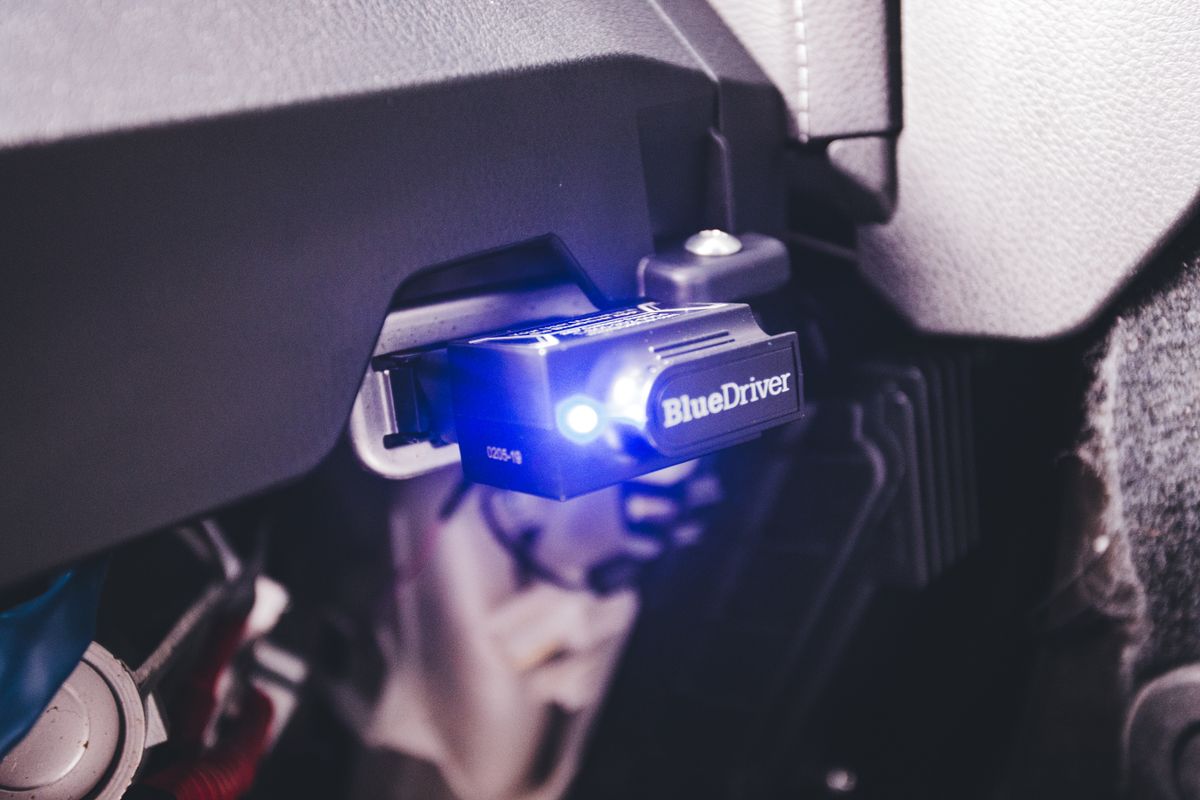
Photo by Erik Mclean on Pexels
Basic OBD2 scanners only pull generic trouble codes and clear light illumination, leaving you blind to intermittent misfires or EVAP leaks. Enhanced scanners such as the ANCEL AD410 add live sensor graphs, freeze frame data, Mode 6 monitoring, and EVAP leak testing required for accurate DIY repairs.
Best choice for
- Basic OBD2 Code Reader ($10-$20) — Sufficient if you only need to confirm a loose gas cap code and turn off the light.
- Enhanced OBD2 Scanner (ANCEL AD410) — Provides live sensor data stream, freeze frame parameters, EVAP leak testing, and I/M readiness status.
- Avoid basic code readers if you are diagnosing intermittent driveability issues, vacuum leaks, or EVAP trouble codes (P0440-P0457).
- Avoid basic tools if you need to pass a state emission test and verify monitor completion status.
- Professional Bi-Directional Diagnostic Tablet — Offers active actuation and ECU coding, but costs $300-$1,000+ which is unnecessary for standard DIY maintenance.
Featured DIY Diagnostic Tool
The recommended enhanced scan tool for home garages:
Real-World Diagnostic Scenarios: Where Basic Readers Fail
Scenario 1: Diagnosing an Intermittent Stumble Under Hard Acceleration (P0300) — A basic reader shows 'P0300 Random/Multiple Misfire' but cannot identify which cylinder is failing. An enhanced scanner opens Mode 6 data to reveal exact per-cylinder misfire counts (e.g., Cylinder 3 logged 142 misfires, while others logged 0). You replace the single failing ignition coil on Cylinder 3 instead of replacing all six coils and spark plugs.
Scenario 2: Troubleshooting a Recurring P0442 Small EVAP Leak Code — A basic reader lets you clear the P0442 code, but the light returns 3 days later. An enhanced scanner like the ANCEL AD410 allows you to initiate an EVAP leak test monitoring sequence, observing fuel tank pressure sensor response while inspecting the purge valve and gas cap seal to confirm the repair immediately.
Scenario 3: Preparing for an Annual State Emission Inspection — A basic reader tells you no codes are stored, but you cleared a light yesterday. You drive to the test station and fail because monitors are 'Not Ready'. An enhanced scanner displays real-time I/M Readiness status, confirming O2, EVAP, and Catalyst monitors have completed their drive cycles before you spend time and money at the inspection station.
How basic and enhanced scanners perform across actual home garage troubleshooting situations:
To understand why enhanced scan tools outperform basic code readers, home mechanics must understand the standard SAE J1979 OBD2 test modes. Standardized across all 1996 and newer light-duty vehicles sold in the United States, these diagnostic modes dictate what information your tool can request from the Powertrain Control Module (PCM).
The 10 Standardized OBD2 Diagnostic Modes
- Mode $01 — Live Sensor Data Stream: Displays real-time engine telemetry including RPM, coolant temperature, vehicle speed, intake air temperature, manifold absolute pressure (MAP), and oxygen sensor voltages. Basic readers only display a couple of core sensors, whereas enhanced tools like the ANCEL AD410 stream and graph multi-parameter live data simultaneously.
- Mode $02 — Freeze Frame Data: Captures a permanent snapshot of engine telemetry at the exact moment an emission-related fault code triggers. Crucial for diagnosing load-dependent or temperature-sensitive failure modes.
- Mode $03 — Stored Diagnostic Trouble Codes (DTCs): Pulls active emission-related codes (e.g., P0301, P0455) that triggered the Check Engine Light.
- Mode $04 — Clear/Reset Diagnostic Information: Clears DTCs, resets Freeze Frame data, and resets all I/M readiness monitor statuses.
- Mode $05 — Oxygen Sensor Monitoring Results: Reads onboard O2 sensor monitoring test results (on non-CAN protocol vehicles).
- Mode $06 — On-Board Diagnostic Component Test Results: Provides raw diagnostic monitoring data for specific components and systems that are not continuously monitored (such as cylinder misfire counts, EVAP canister purge system test counts, and catalyst efficiency thresholds). This is the single most valuable diagnostic mode for DIY mechanics.
- Mode $07 — Pending Trouble Codes: Displays DTCs detected during the current or last driving cycle before they illuminate the Check Engine Light.
- Mode $08 — Evaporative System Integrity Control (Leak Test): Enables an enhanced scanner to initiate a leak test monitoring sequence on the vehicle's EVAP system, assessing fuel tank system integrity.
- Mode $09 — Vehicle Information: Reads VIN number, Calibration IDs (CALID), and Calibration Verification Numbers (CVN).
- Mode $0A — Permanent Trouble Codes: Displays codes that can only be cleared by the PCM itself after confirming the fault has been physically repaired across multiple drive cycles.
Related DIY Diagnostic Guides
Explore additional diagnostic workflows and repair tutorials:
- How to Reset Check Engine Light and Test EVAP Leak System with ANCEL AD410
- How to Diagnose and Fix a P0455 Large EVAP Leak Code at Home
- Top 5 Common Check Engine Light Codes and What They Mean for DIY Repairs
- DIY vs. Pro Check Engine Light Diagnostics: Repair Cost Thresholds Breakdown
Frequently Asked Questions
Answers to common queries regarding OBD2 scanner selection and diagnostic capabilities.
Next Steps: Resolving Your Check Engine Light
Your decision: Select an enhanced OBD2 scanner featuring Mode 6, live sensor data graphing, and EVAP leak test monitoring.
Do this next: Equip your garage with the ANCEL AD410 to diagnose engine codes, monitor live fuel trims, and verify EVAP tank system integrity.
Related resource: Pillar Page: DIY Auto Repair & Cost-Saving Maintenance WorkflowsANCEL AD410 Enhanced OBD2 Scanner
Stop guessing why your Check Engine Light is on. Upgrade from a basic code reader to the ANCEL AD410 Enhanced OBD2 Scanner today, start monitoring live sensor data streams, and perform accurate EVAP system leak tests right in your home garage.
Cover photo by Călin Răzvan on Pexels.