EVAP Monitor Incomplete Smog Test: Why It Happens & How to Fix
Should you drive aimlessly for hundreds of miles to reset an incomplete EVAP monitor before a smog check?
No. An EVAP monitor remains incomplete because the vehicle's Powertrain Control Module (PCM) requires strict enable criteria before initiating its automated leak self-test: a fuel tank level strictly between 25% and 75%, an overnight cold soak where engine coolant and intake air temperatures are within 11°F (6°C) of ambient air, and zero pending diagnostic trouble codes (DTCs). Driving hundreds of highway miles without fulfilling these exact parameters will never trigger the EVAP monitor.
Universal EVAP Drive Cycle Sequence Diagram
- Phase 1: Cold Soak overnight (8+ hours). Is coolant temperature within 11°F of ambient air? → Yes: Proceed to Phase 2: Cold Start & Idle.. No: Wait until engine cools down completely to ambient temperature..
- Phase 2: Cold Start & Idle. Is fuel level between 25% and 75%? → Yes: Start engine, turn on rear defroster and AC load, idle for 2 to 3 minutes.. No: Add or drain fuel to reach 1/4 to 3/4 tank level before cold start..
- Phase 3: City Drive. Accelerate smoothly to 25-35 mph. → Yes: Maintain stop-and-go city speed for 5 minutes, then transition to highway.. No: Avoid aggressive throttle wide-open acceleration..
- Phase 4: Steady Highway Cruise. Maintain 55 mph for 15 minutes. → Yes: Maintain steady pedal (use cruise control if allowed) between 50-60 mph.. No: If traffic disrupts cruise, extend driving time at steady throttle..
- Phase 5: Deceleration & Engine Off Soak. Decelerate to 20 mph without touching brake or clutch. → Yes: Pull over, park vehicle, turn key off, allow engine to soak for 30 minutes. Scan with ANCEL AD410.. No: Repeat steady cruise phase if interrupted by heavy braking..
EVAP Monitor Readiness Failure Modes & Diagnostic Matrix
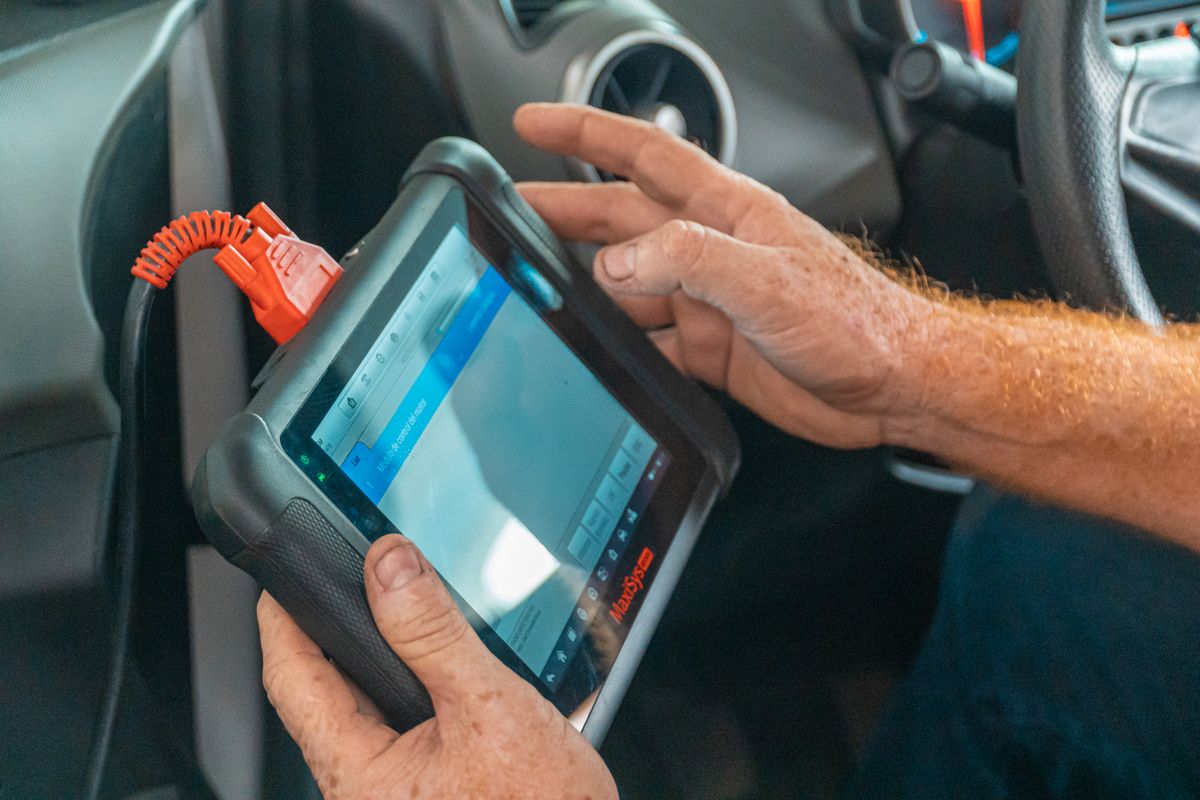
Photo by Jose Ricardo Barraza Morachis on Pexels
| Failure Mode / Scan Status | Underlying PCM Mechanism | Required Enable Criteria | Primary Mechanic Action Step | | :--- | :--- | :--- | :--- | | EVAP Status Stuck 'Not Ready' (Fuel Level Too High) | PCM aborts EVAP leak test to prevent liquid fuel from entering the charcoal canister during purge valve cycling. | Tank level must be 25% to 75% (1/4 to 3/4 full). | Drive vehicle or drain fuel until tank gauge sits between 1/4 and 3/4 full before attempting cold start. | | EVAP Status Stuck 'Not Ready' (Temp Delta Too Wide) | Thermal expansion calculation fails if engine is started warm; PCM suppresses vacuum decay test. | Engine Coolant Temp (ECT) and Intake Air Temp (IAT) within 11°F (6°C) of ambient. | Allow vehicle to cold-soak parked in shade for 8 to 12 hours overnight prior to drive cycle. | | Pending DTC Aborts EVAP Test (e.g., P0128, P0440, P0135) | PCM suppresses non-continuous monitor routines when thermostat or sensor faults impair engine management. | Zero active, pending, or permanent DTCs stored in non-volatile memory. | Plug in ANCEL AD410 to scan pending codes; repair underlying thermostat or sensor failure before monitor run. | | Recent DTC Clear Resets Monitor Memory | Clearing codes with a scan tool or disconnecting battery wipes all PCM I/M readiness flags. | Drive cycle completion required across all emission monitors. | Do not clear codes prior to inspection. Execute targeted EVAP cold-start drive cycle and monitor live readiness. | | Purge / Vent Solenoid Stuck Closed or Open | PCM detects inability to pull vacuum or hold tank pressure during automated self-test. | Sealed fuel EVAP system passing vacuum decay rate test. | Perform EVAP leak test check using ANCEL AD410 or smoke machine to check line integrity and solenoid operation. |
Pro Mechanic Insight: Fuel Tank Level and Cold-Start Temperature Windows
> Master Tech Note: The single most common mistake DIYers make when trying to clear an 'Incomplete' EVAP monitor is filling the gas tank to 100% full or running it down to low fuel. Modern engine control modules (ECUs) run Natural Vacuum Leak Detection (NVLD) or engine-driven vacuum tests only when fuel level is strictly between 25% and 75%. > > Additionally, the ECU checks Intake Air Temperature (IAT) against Engine Coolant Temperature (ECT) at turn-key start. If the delta between the two sensors is greater than 11°F (6°C), the ECU assumes the car hasn't cooled down completely or a thermostat issue exists, immediately cancelling the EVAP diagnostic routine for that trip.
State Smog Inspection Rules: Can You Pass with an Incomplete EVAP Monitor?
- California (BAR / CARB) — For 2001 and newer model year gasoline vehicles, California allows exactly ONE incomplete monitor, provided that single monitor is the EVAP monitor. If any other monitor (Catalyst, O2 Sensor, EGR) is incomplete, or if two monitors are incomplete, the vehicle will fail state inspection immediately. 1996–2000 vehicles permit up to two incomplete monitors.
- Texas (TCEQ / DPS) — 1996–2001 model year vehicles can pass with up to two incomplete readiness monitors. For 2002 and newer vehicles, only ONE incomplete monitor is allowed, which can be the EVAP monitor, provided no active Check Engine Light or DTCs are stored.
- New York (NYVIP3) — 2001 and newer vehicles are permitted to pass state emissions inspection with one incomplete readiness monitor (typically EVAP). 1996–2000 vehicles are allowed two incomplete readiness monitors.
- Florida & Non-Emissions States — Florida currently does not require annual safety or emissions testing. However, keeping the EVAP monitor ready ensures optimal fuel vapor capture, prevents fuel odor, and ensures immediate readiness if registering in an emissions testing state.
Pre-Drive Cycle EVAP Verification Checklist
- [ ] Fuel tank level is confirmed between 25% and 75% full (1/4 to 3/4 full on cluster gauge).
- [ ] Vehicle has rested undisturbed overnight (8 to 12 hours) in a stable ambient environment.
- [ ] Intake Air Temp (IAT) and Engine Coolant Temp (ECT) are within 11°F (6°C) of external ambient temp.
- [ ] OBD2 scan tool (such as ANCEL AD410) confirms ZERO pending or active DTCs in PCM memory.
- [ ] Gas cap seal is intact, free of cracks, and tightened securely until it clicks repeatedly.
- [ ] Electrical accessories (rear defroster, A/C) are ready to operate to load the alternator during initial idle.
EVAP Readiness Monitor Troubleshooting Decision Tree
- Does your scan tool show any Active or Pending DTCs? → Yes: Diagnose and repair pending code first (e.g. P0440, P0442, P0128). Do NOT clear codes after repair if other monitors are ready.. No: Check fuel gauge level.
- Is the fuel tank gauge between 1/4 and 3/4 full (25%-75%)? → Yes: Verify cold-soak conditions.. No: Adjust fuel level. Add fuel if below 25%, or drive until below 75% before performing cold soak.
- Has the vehicle sat parked with engine off for at least 8 hours overnight? → Yes: Perform Universal Cold-Start EVAP Drive Cycle (Idle 3 min -> City drive 5 min -> Steady 55mph cruise 15 min).. No: Park vehicle and allow complete overnight cold soak before turning ignition key.
- Did EVAP monitor status update to 'Ready' on the ANCEL AD410 display after drive cycle? → Yes: Vehicle is ready for state smog inspection!. No: Check state regulations. If EVAP is the ONLY incomplete monitor, proceed to inspection station if single-monitor allowance applies.
Immediate Actions to Ready Your Vehicle for Smog Inspection
Your decision: Determine whether your state allows an incomplete EVAP monitor for your vehicle model year or if a targeted drive cycle is required.
Do this next: Check your fuel tank level to ensure it is between 1/4 and 3/4 full. Connect an OBD2 scanner like the ANCEL AD410 to run a One-Click I/M Readiness test and verify that zero pending codes are blocking the EVAP monitor.
- Read next: State Smog Check I/M Readiness Rules
- Read next: Universal Drive Cycle Sequence Instructions
ANCEL AD410 OBD2 Scanner Code Reader with Live I/M Readiness Hotkey
Follow these practical steps to verify your status and prepare your car for state inspection.
Key Takeaways: Clearing Incomplete EVAP Readiness
- Mileage Alone Will Not Fix It: Driving hundreds of continuous highway miles will not clear an incomplete EVAP monitor without cold starts and specific fuel levels.
- Strict Fuel Window: Fuel tank level MUST remain strictly between 25% and 75% during the drive cycle.
- Cold-Soak Requirement: The engine must sit turned off for 8+ hours until ECT and IAT are within 11°F of ambient temperature.
- Avoid Code Clearing: Never click 'Clear Codes' right before inspection; doing so wipes ALL monitor readiness flags back to incomplete.
- State Rules May Work in Your Favor: Most US states (including California, Texas, and New York) allow 2001+ vehicles to pass smog with an incomplete EVAP monitor as long as no DTCs exist and all other monitors are complete.
- Scan Tool Verification: A dedicated handheld scan tool like the ANCEL AD410 lets you instantly check live I/M status at home before paying for a smog test.
Recommended Tool for Live EVAP Monitoring & Leak Diagnosis
To monitor your I/M readiness status in real time and verify fuel system integrity without costly mechanic fees, an enhanced handheld OBD2 scanner is an essential garage tool.
ANCEL AD410 Enhanced OBD II Vehicle Code Reader
- One-Click I/M Readiness Key: Instantly displays monitor status (including EVAP, O2, Catalyst, EGR) with color-coded readiness LEDs.
- EVAP System Test (Mode 8): Initiates leak test monitoring of the vehicle's fuel tank system to check seal integrity before driving to the inspection station.
- Live Data Stream & Freeze Frame: Monitors Engine Coolant Temperature (ECT) and Intake Air Temperature (IAT) in real time to verify exact cold-start criteria.
- Universal Compatibility: Reads and clears active, pending, and permanent DTCs on standard OBDII, EOBD, and CAN vehicles sold in North America.
Choosing Your Resolution Path: DIY Drive Cycle vs. Scan Tool Diagnostic
Photo by Călin Răzvan on Pexels
Choose whether to attempt a controlled cold-start drive cycle, check state single-monitor allowance, or perform EVAP leak testing.
Best choice for
- Proceed to Smog Inspection Station Immediately — Most states (CA, TX, NY, etc.) allow 2001+ model vehicles to pass emissions inspection with EVAP as the sole incomplete monitor.
- Execute Targeted Universal Cold-Start Drive Cycle — Resolving other monitors while driving will often trigger the EVAP test routine simultaneously once cold-soak parameters match.
- Perform EVAP Leak Test Diagnostic with ANCEL AD410 — Detects micro-leaks, failing purge/vent valves, or loose gas caps preventing the PCM vacuum test from completing.
- Do NOT clear diagnostic trouble codes right before driving to the inspection station; this clears all readiness monitors to Incomplete.
- Do NOT top off the gas tank to 100% full before attempting an EVAP drive cycle.
- EVAP Smoke Machine Leak Test — If code P0442, P0455, or P0456 is pending, a smoke machine identifies physical hose tears, canister leaks, or filler neck seal failures.
EVAP Test Strategies: Purge/Vent Vacuum Monitor vs. Natural Vacuum Leak Detection (NVLD)
| EVAP Diagnostic System Type | Operating Mechanism | Required Fuel Level | Execution Timing Window | Key Sensor Inputs |
| --- | --- | --- | --- | --- |
| Engine-Driven Vacuum (Purge & Vent Solenoid) | PCM opens purge valve while closing vent solenoid during engine engine operation to draw engine intake vacuum into fuel tank. | 25% – 75% Full | During steady cruise (50–60 mph) after engine reaches normal operating temp. | MAP / BARO Sensor, Fuel Tank Pressure (FTP) Sensor, ECT, IAT. |
| Natural Vacuum Leak Detection (NVLD / ESIM) | PCM monitors natural pressure buildup and thermal vacuum decay in sealed tank AFTER engine shutoff during cooldown. | 15% – 85% Full | Engine OFF during overnight cold soak (4 to 8 hours after driving). | EVAP Switch Contacts, Ambient Temp, Fuel Tank Temperature. |
Modern vehicles employ different factory engineering methods to test EVAP system integrity. Understanding your vehicle's EVAP type helps clarify drive cycle requirements.
How to Verify and Clear Incomplete EVAP Status with an OBD2 Scanner
Follow this step-by-step procedure using an enhanced scanner like the ANCEL AD410 to verify monitor readiness and system health:
5 Common Mistakes That Prevent the EVAP Monitor from Running
Avoid these frequent driver errors when trying to reset your vehicle's EVAP readiness monitor:
Frequently Asked Questions About Incomplete EVAP Monitors
Answers to common driver questions regarding smog readiness and EVAP monitor troubleshooting.
Related Smog & EVAP System Resources
- How to Perform an EVAP System Leak Test with an OBD2 Scanner
- Can You Pass Smog Check with Incomplete Monitors? State Rules & Solutions
- How to Reset Check Engine Light and Test EVAP Leak System with ANCEL AD410
Summary & Diagnostic Next Steps
Your decision: Determine whether your vehicle model year and state rules permit passing smog with 1 incomplete EVAP monitor or if executing a cold-start drive cycle is necessary.
Do this next: Verify fuel level is 1/4 to 3/4 full, plug in the ANCEL AD410 scanner to confirm zero pending codes exist, and complete an overnight cold-start drive cycle.
- Read next: Universal Drive Cycle Guide
ANCEL AD410 Enhanced OBD II Code Reader
Take these final steps to clear your EVAP monitor and ensure a smooth state smog inspection experience.
Cover photo by Sergey Meshkov on Pexels.