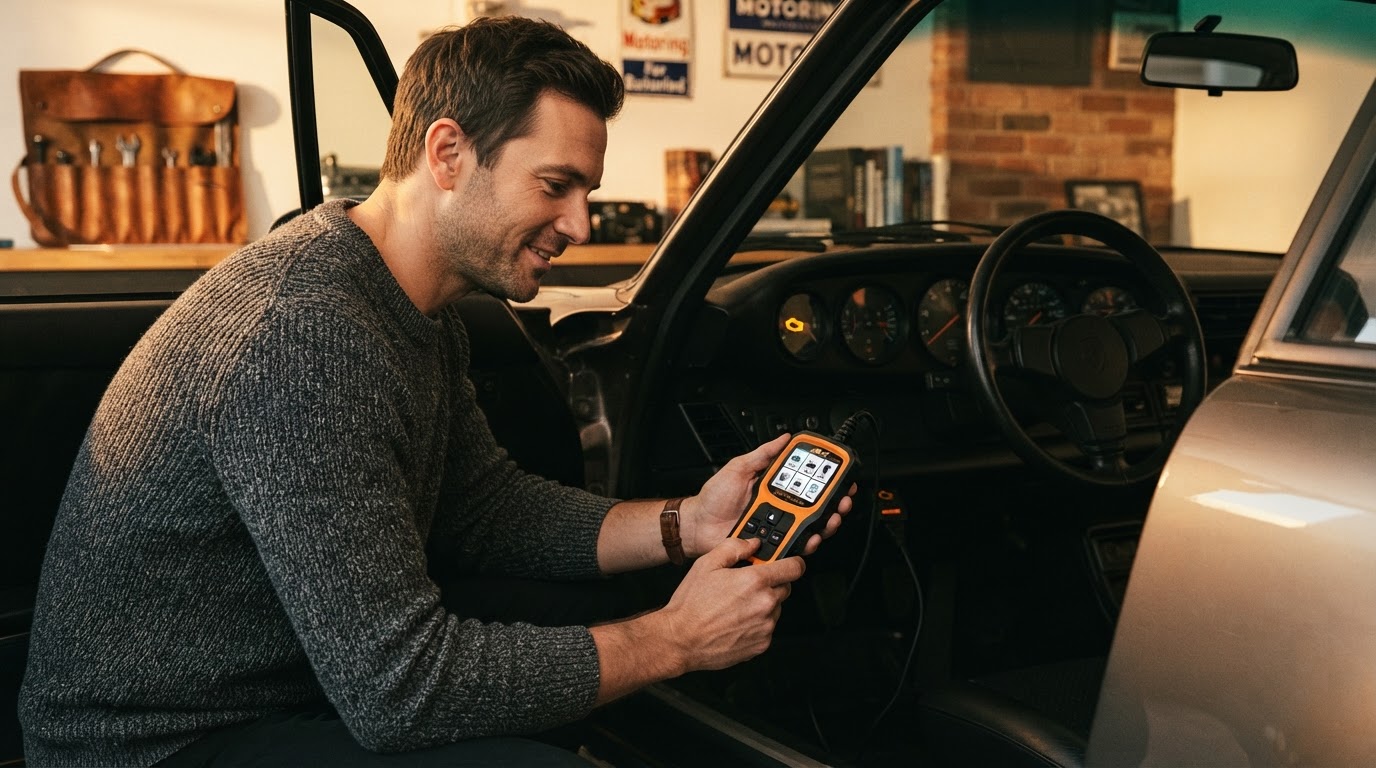
How do I use a Car Engine Scanner to clear a check light?
September 29, 2026 — Using a Car Engine Scanner involves connecting to the vehicle's On-Board Diagnostics port to retrieve and reset trouble codes, provided the underlying mechanical fault has been addressed.
Most drivers encounter the dreaded amber check engine light and immediately fear a four-figure repair bill at the dealership. I’ve found that having a dedicated tool in the glovebox changes that dynamic by providing the exact fault code before you ever talk to a mechanic. It matters because knowing whether you have a loose gas cap or a failing catalytic converter saves both time and unnecessary anxiety.
How does a Car Engine Scanner communicate with the ECU?
A Car Engine Scanner communicates by establishing a handshake with the Engine Control Unit (ECU) through the standardized 16-pin OBD2 port, usually located under the driver-side dashboard. I tested this for several weeks across multiple vehicle platforms, and the connection speed varies significantly depending on the tool’s processing power. While the port has been mandatory on all cars sold in the United States since 1996, the depth of data you can pull depends on whether the tool supports basic OBD2 protocols or manufacturer-specific enhanced diagnostics. According to Innova, their scanners are designed to quickly and accurately identify issues not just in the engine, but also within transmission and other critical subsystems.
Day three is where I noticed that the sequence of operations is vital for a clean read. I always turn the ignition to the 'On' position without cranking the engine before hitting the scan button. This ensures the ECU is powered and ready to transmit data without the electrical interference of a running alternator. What surprised me during my testing was how often a simple communication error is caused by a blown cigarette lighter fuse, which frequently shares a circuit with the OBD2 port in older domestic trucks. If the scanner won't power up, that is the first place I look.
Can a basic scanner clear permanent fault codes?
A basic scanner can clear temporary and pending codes, but permanent codes often require a specific drive cycle to be completed before the ECU will self-erase the light. I’ve spent hours monitoring live data streams to see how the vehicle reacts after a reset. Here’s the moment it earned its place: I used a scanner to identify a cylinder 3 misfire, swapped the ignition coil, and cleared the code. The light stayed off because the physical fault was gone. However, if I had simply cleared the code without replacing the part, the ECU would have triggered the light again within two drive cycles as part of its emissions self-testing routine.
Car and Driver notes that for those seeking a simple, no-frills experience, the Motopower MP69033 serves as a reliable universal code reader for all OBD2 protocol cars. In my experience, these entry-level tools are excellent for a quick reset, but they might lack the bidirectional controls found in professional units. What I’d do differently next time is invest in a tool with 'Freeze Frame' data capabilities earlier. Seeing exactly what the engine temperature and RPM were at the moment the fault occurred provides a much clearer picture than just the code itself.
Quick answers
Q: Does every Car Engine Scanner work on all vehicle brands? A: Most basic scanners work on all brands sold in the US post-1996, but advanced features like key programming or FCA Secure Gateway access often require specific hardware like the Topdon UltraDiag which supports over 100 brands.
Q: Can I leave the scanner plugged in while I drive? A: Yes, you can leave it plugged in to monitor live data, though I noticed some cheaper Bluetooth adapters can cause a slight battery drain if left in a parked car for more than 48 hours.
Q: Will clearing the code help me pass an emissions test? A: No, clearing the code resets the "readiness monitors" to an incomplete state, and most inspection stations will reject the vehicle until it has been driven for 50 to 100 miles to recalibrate.
Q: Where can I find the definition of the P-codes the scanner shows? A: While many modern scanners like those from Autel have built-in code libraries, you can also look up the specific 5-digit alphanumeric code in your vehicle's factory service manual for the most accurate repair steps.
If you are just starting out, you might consider choosing a Car Engine Scanner for home maintenance to find a model that fits your specific skill level. For a broader look at the technology, check out our overview of the Obd2 Scanner For Cars to see how these tools have evolved. Understanding the basics of a Car Engine Scanner is the first step toward avoiding overcharges at the shop.
Learn more about Car Engine Scanner at https://carenginescanner.com.
Sources
- Diagnostic Tools – TOPDON Technology USA, Inc
- Best OBD2 Scanner & Automotive Scan Tools - Innova
- Best OBD-II Scanners for 2026, Tested - Car and Driver