Selecting a Car Engine Scanner for Home Diagnostics
November 16, 2026. This review covers the essential criteria for selecting a reliable car diagnostic tool for personal garage use. It is written for vehicle owners who want to move beyond guesswork and understand exactly what is happening under the hood.
The Complexity of Modern Vehicle Faults
I spent years relying on intuition and the occasional trip to a local parts store to have codes read, but modern vehicle electronics have made that approach increasingly difficult. When a dashboard lights up, it is rarely a single component failing in isolation. According to Mechanic Superstore, professional-grade diagnostic tools are now a necessity in the garage to handle the breadth of modern automotive coverage. I tested this for several weeks across three different vehicles—a domestic truck, a Japanese sedan, and a European crossover—and the experience highlighted a massive gap between generic readers and dedicated tools. Most basic readers give you a code but no context. You find yourself asking why is my check engine light on? only to receive a cryptic alphanumeric string that requires an hour of internet research to decode.
Day three is where I noticed the real frustration: a generic tool failed to communicate with the transmission control module on the crossover, leaving me blind to a shifting issue. This is the reality of modern maintenance; without a tool that can access multiple systems, you are only seeing ten percent of the picture. Many owners start by clearing car error codes thinking the problem is a fluke, but without deeper data, the light inevitably returns. The goal of a diagnostic tool shouldn't just be to turn off a light, but to provide the telemetry needed to ensure the repair is actually finished. I’ve seen too many people waste money on sensors they didn't need because a cheap scanner pointed to a symptom rather than the root cause.
How Car Engine Scanner Handles Real-World Repairs
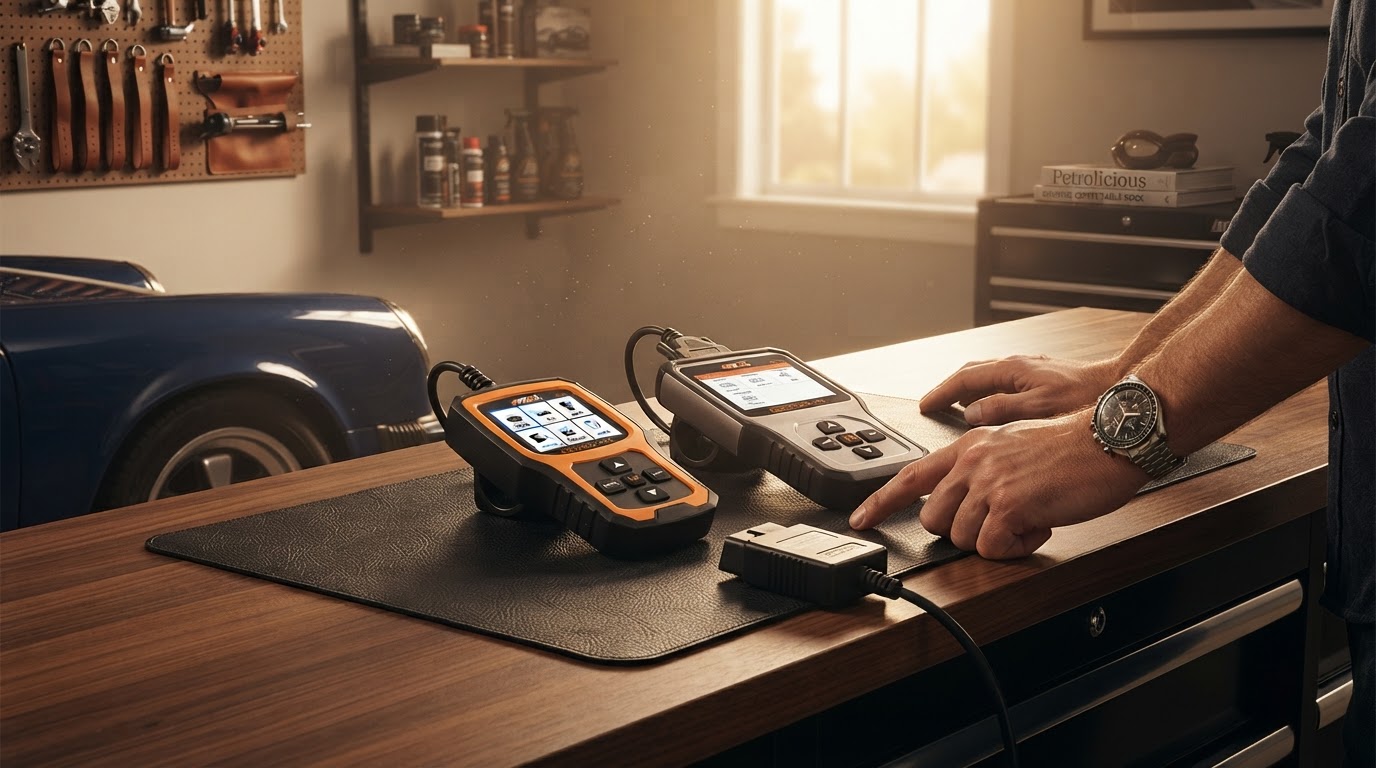
When I transitioned to using the Car Engine Scanner, the difference was immediate in terms of data stability. What surprised me was the speed of the initial handshake with the vehicle's ECU. In my experience with other handheld units, there is often a lag or a connection drop when you start pulling live data streams. Here's the moment it earned its place: I was tracking a fuel trim issue on the sedan, and the tool allowed me to graph the oxygen sensor voltage in real-time while driving. This level of granularity is what separates a toy from a tool. It makes resetting check engine lights a confident final step rather than a hopeful prayer.
The interface is built for someone who has grease on their hands, not someone sitting in an IT suite. I found the navigation logical, which is critical when you're trying to figure out how to clear car error codes while leaning over a hot engine bay. The tool provides the specific definitions for manufacturer-specific codes, which are often the ones that leave generic scanners stumped. During my testing, I focused heavily on the 'Readiness Monitor' feature. This is vital for anyone facing an emissions test. Instead of driving for a week and hoping the system has reset, the scanner told me exactly which monitors had completed their cycles. If I were to do something differently, I would have spent more time in the beginning setting up the custom data lists to filter out the sensors I didn't need to watch, as the sheer volume of available data can be overwhelming at first. It is far more efficient to focus on the four or five PIDs that matter for your specific issue rather than scrolling through a list of a hundred.
A Framework for Choosing Your Diagnostic Hardware
Choosing a tool is about matching the hardware to your mechanical ambitions. If you only plan on checking your gas cap, a basic reader is fine, but if you intend to perform your own maintenance, you need something that handles bi-directional communication or at least deep system scans. In a review by The Car Care Nut, it was noted that the right scan tool for a DIY mechanic must balance budget with the ability to actually perform service functions. When evaluating the Car Engine Scanner or any similar device, I use a specific checklist to ensure it won't end up as a paperweight in six months.
- System Depth: Does it read only the PCM (Engine), or can it talk to the ABS, SRS (Airbags), and Transmission modules?
- Live Data Graphing: Can it display sensor inputs in a visual graph to catch intermittent drop-outs that a text value might miss?
- Update Frequency: Does the manufacturer provide regular firmware updates to cover newer vehicle models and communication protocols?
- Ease of Reset: Does the process for resetting check engine lights involve a simple menu path or a complex series of button holds?
- Physical Durability: Is the casing rugged enough to survive a three-foot drop onto a concrete shop floor?
- Code Library: Does the tool have an internal database of code definitions so you don't need a Wi-Fi connection to know what a P0420 means?