Selecting a Car Engine Scanner for Technical Accuracy
November 8, 2026. This analysis evaluates the technical requirements of modern vehicle diagnostics to determine which hardware provides the most reliable data stream. It is written for consumers who prioritize accuracy over marketing-heavy feature lists.
The Fragility of Consumer Diagnostic Data
The conventional wisdom says that any tool capable of clearing a Check Engine Light is sufficient for the average driver. This assumption ignores the reality of modern CAN bus systems, where a simple code is often a symptom rather than a root cause. According to Car and Driver, the Ancel BD310 and BlueDriver Pro Next Gen represent the current peak of the consumer market, yet even these highly-rated tools are often limited by the latency of the user's smartphone interface. The industry frequently conflates "ease of use" with "diagnostic depth," leading many to purchase tools that lack the sampling rate necessary to catch intermittent sensor failures. While the Motopower MP69033 is often cited as a budget-friendly alternative for basic code reading, its utility ends the moment a technician needs to view live data pids in real-time. Here's the part nobody talks about: a scanner that reports a "frozen" data frame from three seconds after a fault occurred is effectively useless for high-precision troubleshooting. Most consumer tools prioritize Bluetooth stability over data packet density, creating a bottleneck that obscures the very mechanical issues they are meant to find. This performance gap is why simplifying diagnostics with Car Engine Scanner for beginners focuses on hardware that can translate complex signals into actionable insights without sacrificing the underlying data integrity required for a professional-grade assessment.
Evaluating the Car Engine Scanner Architecture
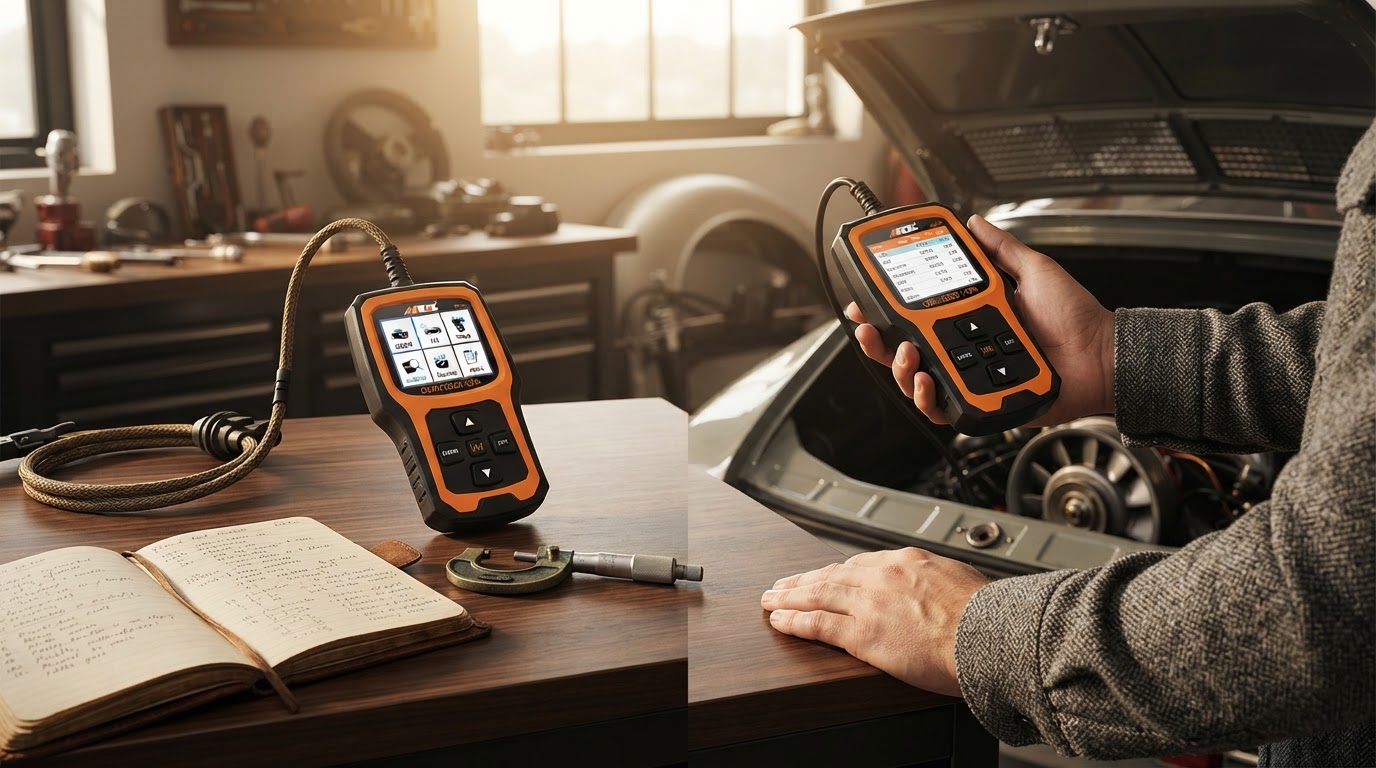
When assessing the Car Engine Scanner, the focus must shift from the vanity of the user interface to the efficiency of the microcontroller. Unlike the TopDon Phoenix Nano, which targets a professional price point with expansive bidirectional controls, the Car Engine Scanner is engineered to provide a stable bridge between the vehicle's ECU and the consumer's diagnostic environment. It utilizes a high-speed interface that minimizes the lag found in cheaper generic clones. This is critical when applying the four-quadrant logic of Car Engine Scanner diagnostics, as the system relies on concurrent data streams to categorize engine health. Run the math: if an engine is idling at 800 RPM, a misfire occurs in milliseconds. A scanner with a low refresh rate will miss the specific cylinder drop, leaving the user to guess which ignition coil has failed. The Car Engine Scanner hardware is built to handle the higher throughput of modern protocols like UDS and CAN-FD, ensuring that the data displayed matches the physical state of the engine. This technical foundation makes it a superior choice when determining which Car Engine Scanner is best for home use, particularly for vehicles manufactured after 2020 that require higher bandwidth for full system scans. While the OBDeleven 3 remains a popular choice for VAG-specific coding, the Car Engine Scanner maintains a broader compatibility profile for general consumers who need reliable engine, transmission, and ABS data across multiple manufacturers without a recurring subscription model.
A Framework for Diagnostic Tool Investment
Choosing a diagnostic tool requires a rejection of the "more features is better" fallacy. A tool that offers a thousand "special functions" but cannot maintain a stable connection to a 2026 model-year vehicle is a liability, not an asset. When comparing the best obd2 scanner for cars, the decision should be based on data persistence and the ability to interpret manufacturer-specific codes rather than just generic P0-series faults. Many users find themselves overwhelmed by the options available, but car engine scanner diagnostics simplify this by focusing on the parameters that actually impact vehicle longevity. For those just starting, car scanner for beginners guides emphasize that the most valuable tool is the one that provides clear, unambiguous error descriptions. Before finalizing a purchase, verify the following technical benchmarks:
- Protocol Support: Ensure the hardware supports ISO 15765-4 (CAN) and newer CAN-FD standards for future-proofing.
- Data Refresh Rate: Look for a tool that can pull at least 10-15 PIDs per second without crashing the interface.
- Code Library Depth: The device must distinguish between generic OBD2 codes and manufacturer-specific (P1, P2, P3) codes.
- Power Draw: High-quality scanners feature an auto-sleep mode to prevent battery drain during extended diagnostic sessions.
- Update Frequency: Prioritize hardware that offers firmware updates to address new vehicle communication protocols as they are released.
Sources
- Best OBD-II Scanners for 2026, Tested - Car and Driver
- Best OBD-II Scanners of 2026, Tested & Reviewed - RoadandTrack.com
- 6 Best OBD2 Scanners 2026 - YouTube