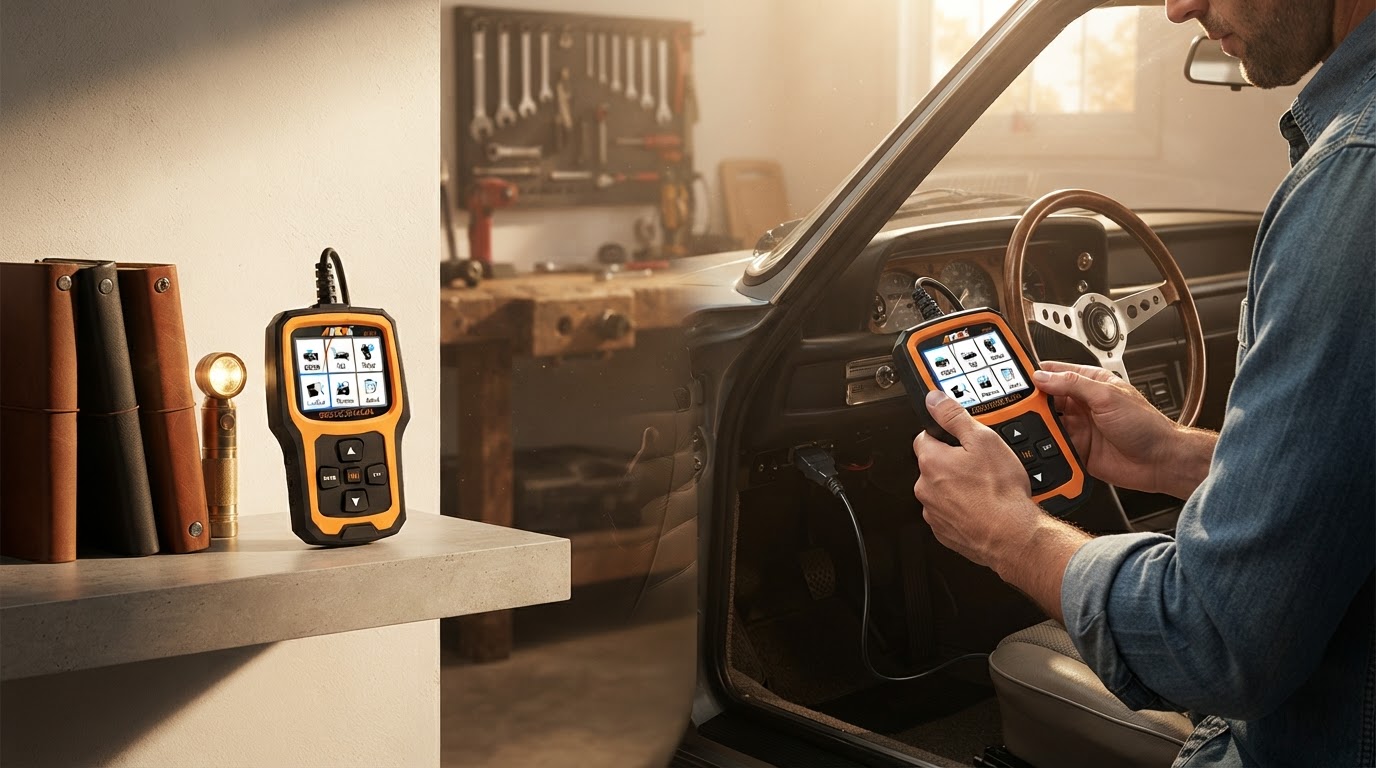
Three Home Mechanic Triage Standards for Car Engine Scanner
August 11, 2026 — The shift toward consumer-grade diagnostic autonomy has accelerated, yet the efficacy of the Car Engine Scanner remains dependent on rigorous triage standards rather than just hardware ownership. While modern vehicles generate thousands of data points, the average user often lacks the protocol to distinguish between a transient sensor glitch and a systemic mechanical failure.
The conventional wisdom says that more data is always better, but Road and Track notes that the BlueDriver Pro Scan Tool is frequently selected for its ability to handle ABS, SRS, and transmission data specifically because raw engine codes are rarely enough for a complete repair. This highlights a critical gap in the market: most tools provide the 'what' without the 'why.' For a home mechanic using a Car Engine Scanner, the goal isn't just code retrieval but the validation of live data streams against factory specifications. Without this secondary layer of verification, a scanner is merely a digital paperweight that leads to unnecessary parts-swapping.
The Three Triage Standards
Photo by Sergey Meshkov on Pexels
Effective diagnostic work requires a specific sequence that bypasses the common pitfalls of DIY repair. First, the mechanic must establish a baseline using the Car Engine Scanner to record Freeze Frame data—the exact snapshot of engine conditions when the fault occurred. Second, the tool must be capable of bi-directional testing to verify component activation. Third, the user must perform a drive cycle to ensure the Readiness Monitors have cleared. Run the math: a typical oxygen sensor replacement costs $150 to $300, yet if the scanner shows the short-term fuel trim is actually the culprit due to a vacuum leak, the owner saves the entire cost of the redundant part. Here's the part nobody talks about: most home mechanics fail because they clear codes immediately, erasing the very evidence needed to find the root cause. A Car Engine Scanner is only as effective as the technician's willingness to resist the 'clear' button. When selecting a car engine scanner for DIY vehicle care, one must prioritize data logging over a flashy interface. The hardware needs to support high-speed PIDs (Parameter IDs) to catch intermittent misfires that slower, cheaper modules miss entirely. This distinction is vital when weighing the budget vs premium home scanners currently available. Furthermore, long-term reliability is a metric often ignored; users should consult an obd2 scanner warranty guide to ensure their investment is protected against the firmware obsolescence that plagues the lower end of the market.
Expert tip: Always check the update frequency for your specific vehicle make; a Car Engine Scanner that hasn't received a database refresh in six months will likely misinterpret manufacturer-specific codes on newer hybrid or EV drivetrains.
I’ll change my mind when entry-level tools include native oscilloscope functions for under $100, but until then, the logic of the diagnostic process remains more important than the brand of the plastic housing. Understanding these limitations is essential for any best obd2 scanner for diy 2024 implementation.